Mold Remediation in Boerne, TX
Fast, professional, and reliable mold remediation services. Available 24/7 for emergencies.
Mold is more than an eyesore — it is a serious health hazard and a sign that your property has an unresolved moisture problem. Following any water intrusion event, mold can begin growing in as little as 24 to 48 hours. Warm Texas summers and the humidity common to the Hill Country create near-perfect conditions for rapid mold colonization. If you see or smell mold anywhere in your Kendall County or Bexar County property, professional remediation is required.
At Water Damage Restoration Boerne TX, we don't just bleach the surface — we identify and eliminate the moisture source, safely remove the mold-affected materials, and restore your property to a safe, healthy condition. Our IICRC-certified specialists use advanced containment procedures, negative air pressure systems, and HEPA filtration to prevent cross-contamination during the removal process.
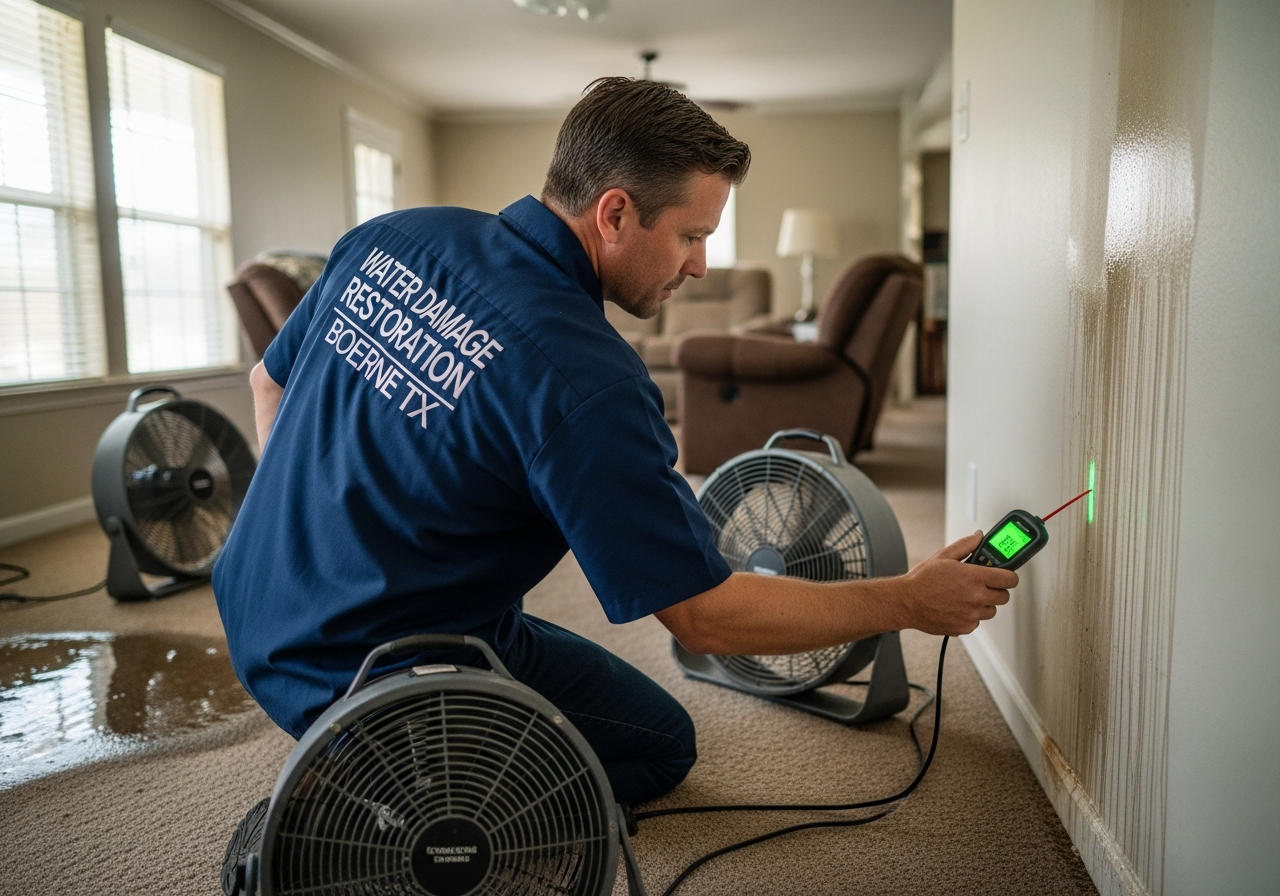
Protect your family's health and your property's value. We provide thorough inspections using moisture meters and thermal imaging, safe removal following IICRC S520 standards, and post-remediation preventative treatments to ensure your environment stays clean and mold-free.
Where Mold Hides in Texas Homes
Mold doesn't always grow where you can see it. Our thermal imaging and moisture assessment reveal hidden mold in the most common problem areas:
- Behind drywall and baseboards — especially after slow plumbing leaks
- In attics — caused by inadequate ventilation, condensation, or roof leaks
- Under flooring — vinyl, tile, and hardwood can trap moisture against the subfloor
- Inside HVAC systems — mold in ductwork can spread spores throughout the entire structure
- In crawlspaces — ground moisture, poor vapor barriers, and flooding create prime mold conditions
- Around windows and doors — condensation and poor weatherstripping allow chronic moisture infiltration
Mold Remediation in the Texas Hill Country
Boerne and Kendall County properties face specific mold risks related to the local climate. Summer humidity levels routinely exceed 70%, and homes that lack proper vapor barriers, attic ventilation, or dehumidification systems are particularly vulnerable. Hill Country homes built on pier-and-beam foundations are also at elevated risk for crawlspace mold due to ground moisture exposure. Our team understands these regional factors and tailors our remediation approach to the specific conditions of each property.
Our Mold Remediation Process
Inspection & Moisture Assessment
We use thermal imaging cameras and calibrated moisture meters to locate all areas of elevated moisture — including hidden mold behind walls, under floors, and inside HVAC systems — before creating a remediation plan.
Containment
Affected areas are sealed with poly sheeting and placed under negative air pressure using air scrubbers to prevent mold spores from spreading to unaffected areas of your home during remediation.
HEPA Air Filtration
High-efficiency HEPA air scrubbers run continuously throughout remediation, capturing airborne mold spores as small as 0.3 microns and cycling room air multiple times per hour.
Mold Removal
Infested porous materials (drywall, insulation, compromised wood framing) are carefully removed and bagged for disposal. Non-porous surfaces are treated with EPA-registered antifungal agents.
Content Cleaning & Deodorization
Personal property, furniture, and belongings that can be saved are cleaned using specialized techniques, and the entire space is deodorized to eliminate the musty mold odor.
Restoration & Clearance
Removed materials are replaced, and a final clearance inspection confirms that spore levels have returned to normal. We can coordinate third-party air testing for complete peace of mind.
Frequently Asked Questions
How fast does mold grow after water damage?
Mold can begin colonizing within 24 to 48 hours of a water intrusion event. The Texas Hill Country's warm climate and high humidity create near-perfect conditions for accelerated mold growth — mold spores that land on wet drywall, wood framing, or insulation can start producing visible colonies in as little as 24 hours. This is why professional water extraction and drying must begin immediately after any flooding event, not days later.
Is bleach effective for killing mold?
Bleach is not recommended for mold remediation by the IICRC or the EPA. While bleach can kill surface mold on non-porous materials like tile or glass, it cannot penetrate porous materials like drywall, wood, or insulation — where the mold roots (hyphae) live. Bleach also releases chlorine gas in enclosed spaces, creating a health hazard. Professional remediation uses EPA-registered antifungal and antimicrobial agents that penetrate porous materials and address the root cause of the growth.
Do I need a mold test before remediation?
Pre-remediation air testing can be useful for confirming the presence of elevated mold spore counts and identifying the species, but it is not always required before beginning work. Visible mold growth is itself sufficient to proceed with remediation. Post-remediation air testing (clearance testing) is recommended to verify that the remediation was successful and that spore counts have returned to normal levels. We can coordinate with independent certified industrial hygienists (CIHs) for third-party clearance testing.
Can mold make my family sick?
Yes. Mold exposure can cause a range of health effects, from mild allergic reactions (sneezing, runny nose, itchy eyes) to more serious respiratory issues in people with asthma, allergies, or compromised immune systems. Certain mold species — including Stachybotrys chartarum (often called 'black mold') — can produce mycotoxins that cause more severe symptoms with prolonged exposure. Children, the elderly, and immunocompromised individuals are most at risk. If anyone in your household is experiencing unexplained respiratory symptoms, mold should be investigated immediately.
Will my homeowners insurance cover mold remediation?
Coverage for mold depends on the underlying cause. If the mold resulted from a covered water damage event — such as a burst pipe or appliance overflow — most Texas homeowners insurance policies will cover the mold remediation as part of the claim. However, mold caused by long-term neglect, maintenance failures, or pre-existing conditions is typically not covered. Our team documents the connection between the water damage event and the mold growth to support your insurance claim.
How long does mold remediation take?
A typical residential mold remediation project takes 1 to 5 days, depending on the extent of the contamination and the number of rooms affected. Small localized mold problems (less than 10 square feet) can often be addressed in a single day. Larger infestations involving multiple rooms, attic mold, or crawlspace mold require more extensive containment and take longer. We provide a clear timeline estimate after our initial inspection.